
Cardiovascular Health
A clinical reference for UK primary care
Last reviewed 31 August 2026 · Next review November 2026
Cardiovascular disease is the UK's biggest single cause of premature death and a major driver of health inequalities. Around 7.6 million people across the UK live with a heart or circulatory disease.1
CVD prevention is built around two NICE guidelines that primary care delivers most: NG238 for risk assessment and lipid modification, and NG136 for hypertension. NG238 specifies QRISK3 as the current risk tool, with a 10-year score of 10% or more as the threshold to offer a statin, and shared decisions for those below the threshold.2,3
Most cardiovascular risk management happens in primary care. Specialist input is reserved for established disease, suspected secondary causes, or where risk factors are difficult to control.2,3
In July 2026 the Department of Health and Social Care published the Cardiovascular Disease Modern Service Framework, a ten-year strategy for England setting out 12 priorities for the first three years.9 It sets an ambition to reduce premature deaths from heart disease and stroke by 25% within a decade, and reframes prevention around combined cardiovascular, kidney and metabolic risk rather than cardiovascular risk alone.
The commitment with the most direct bearing on general practice is the target to raise the proportion of people with diagnosed hypertension who are treated to target to 80% within three years.9
Recent in cardiovascular health

29 Aug 2026
What your heart failure register is not telling you

25 Aug 2026
Semaglutide for secondary cardiovascular prevention: An update that may have gone unnoticed – what NICE TA1152 means for primary care

21 Jul 2026
Finerenone gets NICE backing for HFpEF and HFmrEF: what the final draft guidance means for primary care

21 Jul 2026
Triglyceride-associated cardiovascular risk: Leaving risk on the table

1 Jun 2026
Lipoprotein(a): The Overlooked Cardiovascular Risk Marker You Should Know About
26 May 2026
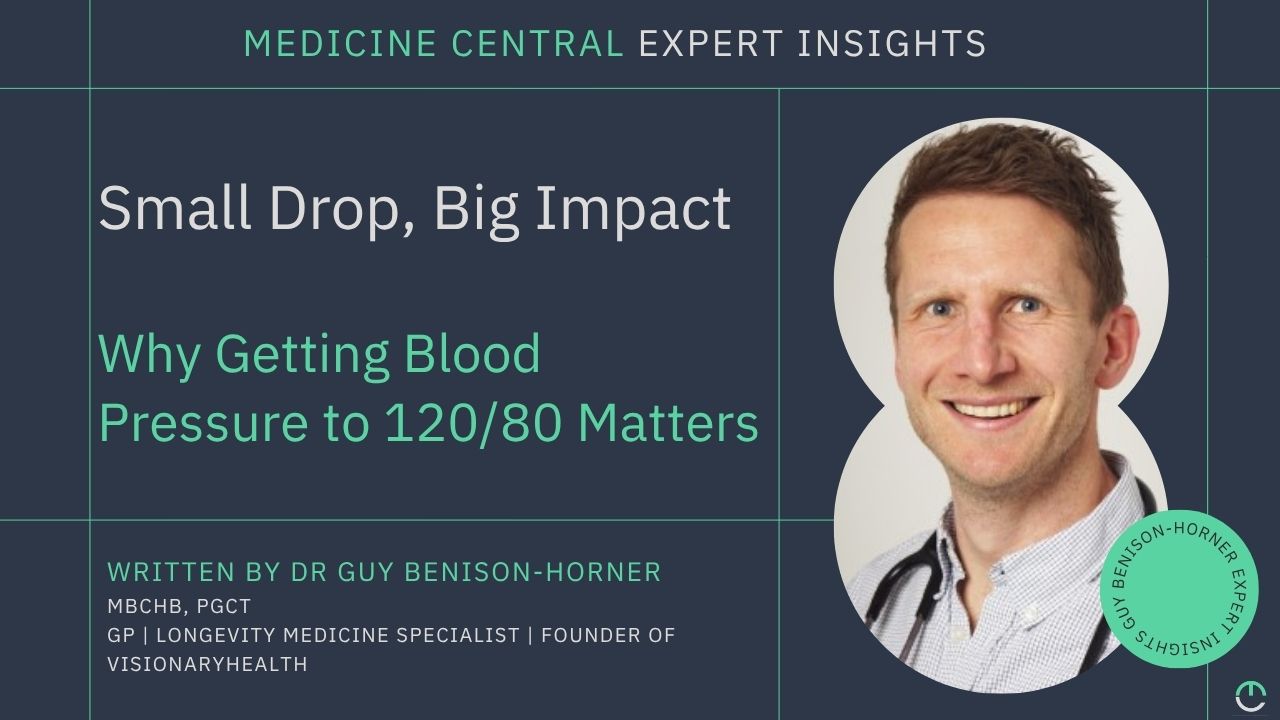
Small Drop, Big Impact: Why Getting Blood Pressure to 120/80 Matters

27 Mar 2026
COBRRA delivers the first head-to-head DOAC comparison in VTE

19 Mar 2026
Statins past 80: what does the evidence actually say?

19 Mar 2026
What could the future antihypertensive medication landscape look like?

5 Feb 2026
The art of 'Diagnostic Elegance': refocusing the hypertension review
Hypertension diagnostic thresholds
Diagnosis requires both an elevated clinic measurement and confirmation by ambulatory blood pressure monitoring (ABPM) or home blood pressure monitoring (HBPM). Per NG136.3
Stage 1 hypertension
Clinic ≥140/90 · ABPM/HBPM ≥135/85 mmHg
In adults under 80, NG136 recommends discussing antihypertensive treatment if target organ damage, established CVD, renal disease, diabetes, or 10-year CVD risk ≥10%.
3Stage 2 hypertension
Clinic ≥160/100 · ABPM/HBPM ≥150/95 mmHg
NG136 recommends offering antihypertensive treatment to adults of any age.
3Stage 3 / Severe hypertension
Clinic ≥180/120 mmHg
Same-day specialist review if signs of retinal haemorrhage, papilloedema, life-threatening symptoms, or suspected phaeochromocytoma.
3BP target: 80 and over
Clinic <150/90 · ABPM/HBPM <145/85 mmHg
Use clinical judgement in frailty or multimorbidity.
3CONFIRMING THE DIAGNOSIS
A single clinic reading is not sufficient. Confirm with ABPM (or HBPM if ABPM unsuitable). HBPM thresholds are 5 mmHg lower than clinic measurements. Investigate for target organ damage and assess CV risk while awaiting confirmation.3
Identifying those at risk
PRIMARY PREVENTION
QRISK3 ≥10%
NG238 recommends offering a high-intensity statin for primary prevention of CVD where 10-year QRISK3 score is 10% or more. For QRISK3 below 10%, do not rule out treatment if there is informed preference or risk may be underestimated.2
RISK TOOLS
QRISK3 (ages 25 to 84)
QRISK3 incorporates risk factors not in QRISK2: severe mental illness, corticosteroid use, atypical antipsychotics, SLE, migraine, erectile dysfunction. Some clinical systems still use QRISK2; the 10% threshold applies to either.2,4
WHERE QRISK3 IS NOT APPROPRIATE
High-risk groups
Do not use QRISK3 for adults with type 1 diabetes, eGFR <60 mL/min/1.73m² with or without albuminuria, or familial hypercholesterolaemia. These are treated as high-risk by default.2
Treatment after an established cardiovascular event
Most of this page covers primary prevention. For people who already have established cardiovascular disease, a new option entered the pathway in May 2026.
Semaglutide for reducing major adverse cardiovascular events
NICE recommends semaglutide, up to a maintenance dose of 2.4 mg once weekly and alongside a reduced-calorie diet and increased physical activity, as an option for reducing the risk of a major adverse cardiovascular event in adults with established cardiovascular disease and a body mass index of 27 kg/m2 or more.8
What counts as established cardiovascular disease
TA1152 defines this as at least one of: previous myocardial infarction; previous ischaemic or haemorrhagic stroke; or symptomatic peripheral arterial disease, meaning intermittent claudication with an ankle brachial index below 0.85 at rest, or previous revascularisation or amputation.8 Type 2 diabetes is not required.
WHERE THIS IS INITIATED
TA1152 does not specify a treatment setting. Whether initiation sits in primary care or with a specialist service is determined by local pathways and commissioning arrangements.8
Finerenone for preserved and mildly reduced ejection fraction
NICE published TA1182 on 5 August 2026. Integrated care boards, NHS England and local authorities must comply with it within 90 days of publication, which is by 3 November 2026. In Wales, the NHS must usually provide funding within 60 days of first publication of the final draft guidance.10
What NICE recommends
Finerenone can be used, within its marketing authorisation, as an option to treat symptomatic chronic heart failure with preserved or mildly reduced ejection fraction in adults.10
Ejection fraction bands
Preserved ejection fraction is an LVEF of 50% or more. Mildly reduced is 41 to 49%. Reduced is 40% or less. The marketing authorisation covers symptomatic chronic heart failure with an LVEF of 40% or more.10
Where it sits in the pathway
NG106 recommends considering a mineralocorticoid receptor antagonist and an SGLT2 inhibitor in heart failure with preserved ejection fraction. In mildly reduced ejection fraction it also recommends considering an ACE inhibitor, or an angiotensin II receptor blocker if not tolerated, and a beta blocker.5 The MRA recommendation covers both steroidal MRAs, such as spironolactone and eplerenone, and non-steroidal MRAs, such as finerenone.
Comparison with spironolactone
Finerenone has not been compared directly with spironolactone in this population. NICE concluded that the results of the indirect comparison and the real-world evidence analyses are uncertain, so it is unclear how well finerenone works compared with spironolactone.10
STEROIDAL AND NON-STEROIDAL MRAS ARE NOT USED TOGETHER
Because the existing NG106 recommendation on mineralocorticoid receptor antagonists covers both classes, finerenone is a choice within that recommendation rather than an addition on top of a steroidal MRA.10
The evaluation committee heard that steroidal MRAs are often not started, or are not well tolerated, in this population, which is more commonly older, frail and multimorbid. Finerenone carries a lower risk of anti-androgenic effects such as gynaecomastia, and clinical experts described it as more likely to be suitable for people with hypotension or chronic kidney disease. The risk of hyperkalaemia is likely to be similar to spironolactone, and may be slightly lower.10
Lipid response targets
PRIMARY PREVENTION
Non-HDL ≥40% reduction
NG238 specifies a 40% reduction in non-HDL cholesterol from baseline at 2 to 3 months on a high-intensity statin as the response target.2
SECONDARY PREVENTION
LDL-C 2.0 mmol/L or below
For secondary prevention of cardiovascular disease, NG238 sets a treatment target of LDL cholesterol of 2.0 mmol/L or below, or non-HDL cholesterol of 2.6 mmol/L or below.2 This replaced the previous approach of starting a statin without a defined treatment target.
CVD risk assessment in primary care
The five-step pathway that primary care delivers under NG238.2
Identify
Adults aged 25 to 84 not already known to be at high risk
Measure
Lipids, BP, HbA1c, smoking status, family history
Calculate
10-year CVD risk using QRISK3
Discuss
Shared decision around lifestyle and statin treatment
Initiate
High-intensity statin if QRISK3 ≥10% and patient agrees
Review
Lipid response at 2 to 3 months; aim for ≥40% non-HDL reduction
Referral pathways
Clinic BP ≥180/120 mmHg with retinal haemorrhage or papilloedema, life-threatening symptoms, or suspected phaeochromocytoma (labile or postural hypotension, headache, palpitations, pallor, abdominal pain, diaphoresis).3
Suspected heart failure (NG106): NT-proBNP above 2,000 ng/L, 2-week referral; 400 to 2,000 ng/L, 6-week referral. Suspected angina or ACS, suspected arrhythmia requiring assessment, abnormal ECG, or established CVD with poorly controlled risk factors.5
Suspected familial hypercholesterolaemia (per CG71). Adults with statin intolerance after trying alternatives. Consideration of specialist lipid-lowering therapy beyond statins.6
Resistant hypertension (uncontrolled despite optimal doses of three agents including a diuretic). Suspected secondary causes including primary aldosteronism, renovascular disease, or rare causes.3
Suspected TIA: same-day assessment per NG128. Established stroke or TIA: secondary prevention pathway including antiplatelet, statin and BP optimisation.7
Find all NICE updates relevant to primary care
View NICE GuidelinesThis disease hub is intended for UK Healthcare Professionals only. Content reports established clinical knowledge and current NICE guidance. It is not a substitute for clinical judgment or for the original guidelines. Last reviewed 31 August 2026.
References
All sources verified at last review. Where primary literature is cited, original peer-reviewed publications are linked.
- 1.British Heart Foundation. UK Cardiovascular Disease Statistics Factsheet. Latest edition.
- 2.National Institute for Health and Care Excellence. Cardiovascular disease: risk assessment and reduction, including lipid modification. NICE guideline NG238. Published December 2023.
- 3.National Institute for Health and Care Excellence. Hypertension in adults: diagnosis and management. NICE guideline NG136. Published August 2019, updated November 2023.
- 4.Hippisley-Cox J, Coupland C, Brindle P. Development and validation of QRISK3 risk prediction algorithms to estimate future risk of cardiovascular disease: prospective cohort study. BMJ. 2017;357:j2099.
- 5.National Institute for Health and Care Excellence. Chronic heart failure in adults: diagnosis and management. NICE guideline NG106.
- 6.National Institute for Health and Care Excellence. Familial hypercholesterolaemia: identification and management. NICE guideline CG71.
- 7.National Institute for Health and Care Excellence. Stroke and transient ischaemic attack in over 16s: diagnosis and initial management. NICE guideline NG128.
- 8.National Institute for Health and Care Excellence. Semaglutide for reducing the risk of major adverse cardiovascular events in people with cardiovascular disease and overweight or obesity. Technology appraisal guidance TA1152. Published 7 May 2026.
- 9.Department of Health and Social Care. Cardiovascular disease modern service framework. Published 7 July 2026.
- 10.National Institute for Health and Care Excellence. Finerenone for treating chronic heart failure with preserved or mildly reduced ejection fraction. Technology appraisal guidance TA1182. Published 5 August 2026.